 Italy for me From Italy with love

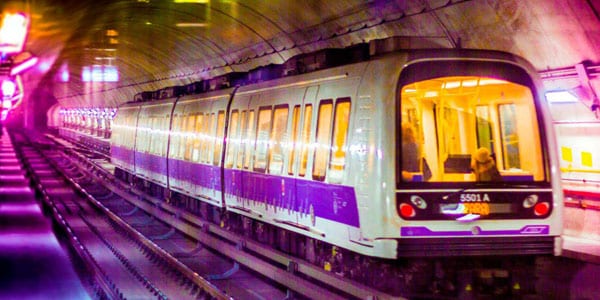
The Milan Metro (Metropolitana di Milano) was inaugurated in 1964. The underground network covers the city extensively and even stretches beyond its borders. Four lines and over one hundred stations help residents and visitors save valuable travel time.
Page Contents
Map
The Milan Metro system has a total railway length of about 59 miles (95 km). It features both underground and above-ground sections. The metro map shows four distinct lines.
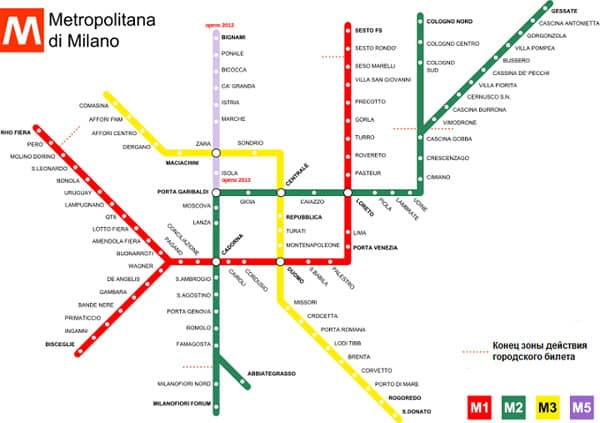
Red Line (M1 Line, Linea M1)
This was the first metro line built in Milan. Construction began in 1957, leading to the opening of the first section in 1964. The M1 line spans 17 miles (27 km), connecting the northeast and northwest of the city, with a short branch extending to the southwest. The starting station is Sesto 1º Maggio, and the endpoints are Rho Fiera Milano and Bisceglie.
The Red Line features 37 stations. Travelers can transfer to the Green Line at Loreto and Cardona stations and to the Yellow Line at Duomo station.
Green Line (M2 Line, Linea M2)
Stretching for 24.5 miles (39.5 km), it has 35 stations. This line connects Milan’s northeast to its southern areas. The terminal stations are Gessate, Cologno Nord, Milanofiori Forum, and Abbiategrasso. Several stations in the southern segment are above ground. Between Famagosta and Milanofiori Forum, the metro transitions smoothly into a suburban railway linking Milan with the town of Assago.
Yellow Line (M3 Line, Linea M3)
Running for 10.5 miles (17 km), it has a total of 21 stations. The relatively new Yellow Line was completed in 1990 to connect northern and southern Milan. The line runs between Comasina in the north and San Donato in the south. Travelers on the M3 Line can easily transfer to other metro lines: the M1 Line at Duomo station, the M2 Line at Centrale station, and the M5 Line at Zara station.
Purple Line (M5 Line, Linea M5)
The newest metro line in Milan, which began operating in early 2013. The trains on this line are fully automated and operate without human drivers. This line runs from the northeast of the city to the west, connecting Bignami and San Siro Stadium (San Siro Stadio). Transfer stations to other lines include Zara (M3), Garibaldi FS (M2), and Loto (M1).
M4 Line
The Milan Metro was expected to improve significantly with the addition of the M4 line, which was initially planned to open in 2015 to coincide with the Expo 2015. However, funding delays postponed its activation, and the M4 line only started operating a few years ago.
Each metro line is represented by its own color on the map. Additionally, station interiors and train designs are themed according to their line colors.
The Milan Metro system is also connected to the city’s Passante Ferroviario commuter train line, which includes eight above-ground stations.
City metro tickets are also valid for travel on 14 suburban railway lines (Linee ferroviarie suburbane Milano). You can view a detailed map on the official website www.trenord.it.
Useful Information
The M1 Line is the most useful for tourists, as it provides easy access to Milan’s main attractions, including the Milan Cathedral (Duomo), the Galleria Vittorio Emanuele II, and various museums and exhibition centers.
The M2 and M3 lines (at Centrale station) are ideal for travelers needing quick access to Milan’s central train station (Milano Centrale).
Operating Hours
From 6:00 AM to 12:30 AM, with trains running every 5 to 10 minutes. On two holidays, December 25 and May 1, the service hours are reduced, operating from 7:00 AM to 7:30 PM.
Ticket Prices
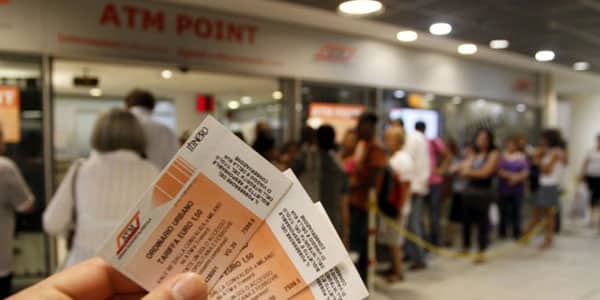
For tourists planning to visit Milan, it is useful to know that the ATM transport company operates not only the metro but also other forms of city transportation, including buses, trams, and commuter trains. Travelers can purchase tickets valid for all types of municipal transport:
- Urban Ticket (Biglietto Urbano) — costs €2.20 ($2.35) and is valid for 90 minutes after validation. It covers one trip on surface transport, the metro, or the city train.
- 10-Trip Ticket (Carnet 10 viaggi) — costs €19.50 ($20.85) and includes 10 trips, each valid for 90 minutes under the same conditions as the Urban Ticket.
- One-Day Ticket (Biglietto giornaliero) — costs €7.60 ($8.15) and is valid for 24 hours after validation across all types of city transportation, including the commuter train.
Using a rechargeable plastic card called “RicaricaMi” makes traveling even more convenient. This card can hold four types of tickets. The base cost of the card is €2.50 ($2.70), which covers one trip. Afterwards, travelers can load additional types of tickets onto the pass as needed.
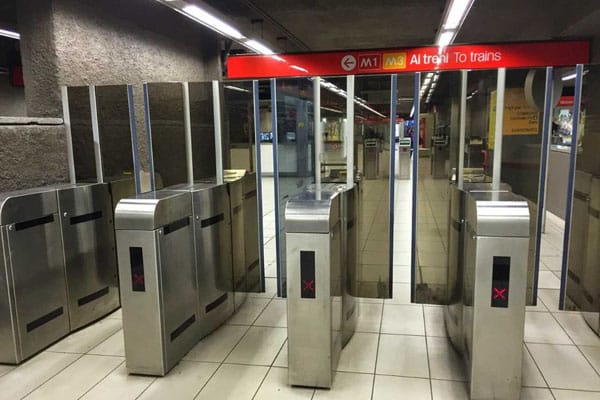
Remember that both paper and electronic tickets must be validated at the start of your journey. Ticket inspectors are active in the metro and can impose a fine of €100.00 ($107.00) on fare evaders!
Where to Buy Tickets
You can buy tickets or recharge your RicaricaMi card at special vending machines inside metro stations. Milan offers around 2,200 ticket points, including tobacco shops, newsstands, bars, and public transport stops. Additionally, sending an SMS with the word “ATM” to 48444 allows you to pay for a single metro ride for €1.50 ($1.60).
You can plan your trip, view the metro map, and check ticket prices on the metro’s official website. The site is available in both Italian and English. Essential information in Russian is summarized in this article. 🙂
- Official website: www.atm.it
- Online metro map: www.giromilano.atm.it